Wednesday, April 27, 2011
The Buildings of San Miguel de Allende – Part 5
Tuesday, April 19, 2011
People Getting Around in San Miguel de Allende – Part 4
I also thought that the following set of photographs had a demand for attention. From many people I've met here in San Miguel there is this understanding of 'Mexican time'. For all things, it generally takes longer and can be further delayed at any time.
With Fed Ex being known for its speed, I couldn't help but notice the context of the old bent man in his blue jacket, sitting with his walker beside this sign. Is this an employee waiting for his next delivery? His orange peels also tie connection back to dual color sign.
It almost seems perfect when a complimentary color walks into the field of view. I like this version better because the door balances out nicely with the man. Whereas the other photo with the windows along the wall didn't quite match the image.
On another part of town there was a man delivering some sort of goods to local stores while using a laden down donkey as his delivery vehicle. Several days later I saw, in more residential parts of town, a man with 6 fully loaded donkeys like below.
This man on a horse in historic dress is actually an on-duty policeman of San Miguel. As far as I can tell, there are 2 of these officers in town.
San Miguel is known for its strong bright colours. These can at times be all mashed together in one block. The red scooter adds to the dominance of the bold window on the red wall.
Niels Henriksen
Monday, April 11, 2011
People of San Miguel de Allende Mexico– Part 3
It seems that almost every weekend, sometimes even during the week, there is some sort of festival underway which eventually winds up in the main town centre, 'Le Jardin'.
On one Friday there was a large school cultural event which I think was in its 4th year, at least with my best translation. There where hundreds of kids in colourful transitional costumes. Each group took turns on stage performing their routines.
There are many beggars throughout the downtown core. It's obvious that they are poor, especially with the average daily wage in Mexico of $15.00US. But the troubling part is that during tourist season, some men drop off their wives, kids and even their mothers to beg 12 hours a day. Some women even have babies cradled in their arms. There are very young children sitting all day in the same spot with their mothers not doing anything. It seems such a waste.
Niels Henriksen
Wednesday, March 30, 2011
San Miguel de Allende - Part 2
Just up the hill of Park Juarez towards Casa de Sierra Nevada are trees loaded with Great White Egrets this time of year.
When he lands beside his mate, this is the gentle tug-of-war between them for several seconds which can be seen in the photo below.
Just beside the hotel are a lot of steps that lead up to a favorite lookout point. I had to stop twice to rest on the way up.
The church with spires is 'La Paroquia' and to the left is the 'Bellias Artes', the national institute of Fine Arts. To give the front building more emphasis I desaturated the background a little. Otherwise the important items get lost in the details.
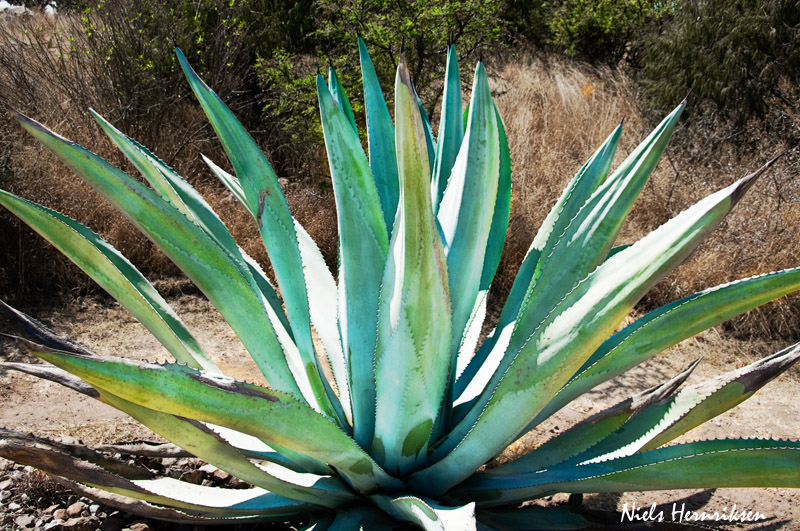
If you continue up from here, you will find the 'El Charro del Ingenio' Botanical Gardens. San Miguel in the winter is very dry, hasn't rained once in 5 months and therefore one would expect more desert like plants. I am sure that in the raining summer months the foliage must explode in flowers before the next drought starts.
Throughout the town, the Jacaranda trees are in full bloom. It's a bit strange to see a vivid lilac-purple tree with no green leaves.
I love this place. People are very friendly and the food is great.
Niels Henriksen
Wednesday, March 23, 2011
San Miguel de Allende - Part 1
San Miguel is situated at 6,000 feet and therefore the heat from the direct sun is more intense. Even fully clothed it seems to go right through you. The air is thinner and very dry and while you don't seem to sweat you are still loosing a great amount of water.
It is so true what the say here at least for newbies. Drink lots of water and only walk on the shady side of the street.
San Miguel is a world heritage site and once here, it is quite evident why.
Most of the buildings have strong burnt orange and yellow painted exteriors. Here I wanted the tree shadows to add texture and more interest to the strong colors.
Some people are not afraid of strong colors as is shown by the blue exterior accented with yellow and green.
Just having images of colorful buildings after a while can be boring so having other context such as humans, animals of events create that focal interest as can be seen by the worker with his feet dangling out the window. Even his orange vest compliments the wall colors.
I only have my laptop with me and it's not color calibrated and by inherent design, have a strong contrast and high color temperature. It will be interesting to see how the look at home. I will redo the RAW on a color calibrated computer and compare them.
The Laser light show on the 'La Paroquia the dominant attraction in San Miguel de Allende and bordering 'Le Jardin', is quite vivid and interesting to watch. At one point they had vines growing up around the towers and spires.
Scary but fun to watch. These night scenes were all shot at ISO 6400 and are only lit by yellow street lamps. It's therefore hard to extract any true colours.
Niels Henriksen
Monday, March 7, 2011
Why I Don't Worry About Image Theft on the Web
The web is effectively still in its infancy and we need to understand the risk and potential harm either from lost revenue or damage to you or someone else's reputation etc.
In my case, the artistic medium of choice is large printed photographs. The web images I show are like showing a snapshot of my son as compared to you meeting him in person. If you take the snapshot, I still have him.
Since my printed photographs are at a minimum 14” (4,200 pixels) and since there is no program that can create that much new information from a web image, the risk of theft here is minimal. Also, my photographs are signed and numbered, and this creates impressions in the paper especially heavy mat. For signed images the risk is very minimal.
But even the web images have merit and I don't give them away for free. At least not free for the taking. I keep image size down to 800 pixels and use 9 of 12 compression ratio for jpeg. The images are watermarked with a small signature. At least they can say they didn’t know whose images it was. The meta data is kept within the jpeg file and this contains the copyright notice and other information.
You can never stop all theft, just look at the famous artworks in museums but you can reduce the risk.
In deciding risk you should consider:
Who:
It seems that there is theft from all walks of life but don’t forget the ones that you inadvertently give away for free like contests, web sites and the famous case on Twitter with the Haiti images. Do read the fine print and especially those sections that deal with Rights or licenses.
Size:
Images can range from either a thumbnail image on a web page to the brochure cover.
Size does matter and the smaller the better. With bigger photos there are more places it can be used. If your photos are in demand then 600 or even 400 pixels is not unreasonable. Viewers can always ask to see larger and you can decide on risk.
Genre:
If your are producing images that are in demand and this changes regularly, they take it. If it's general tourist type, then probably not a big deal. Even sometimes there is a need for nostalgia in a venue. Old and borrowing can become rediscovered and exciting.
If it's cutting edge advertising then watch out.
Harm:
Harm can come from monetary loss of a potential sale. Someone sold an image of yours. If you don't make a living by selling your images then harm is not as drastic but still, it is money that should have been yours. They should have come to you to ask. When you post images, do make it easy for anyone to see how to contact you and whether your images are creative commons (CC) etc.
Harm can also arise from identity theft from using image of a person in another's context or even harm from image identifying scene information that could lead to yours or someone else harm.
That is why I limit my own family and friends exposure.
If I do find any photos of mine stolen I will pursue rigorously as warranted. That is one thing you need to do in order to let courts know that theft is a legal concern for you and always has been and not just now because of large financial amount involved.
Do not forget that theft or loss can also happen if your online storage is your only source and the firm either changes entities or no longer exist.
Niels Henriksen
Monday, February 28, 2011
San Miguel de Allende
I know you were expecting photos. Well so am I. We are heading of the this lovely place for the month of March. I am quite excited about it as its my first trip where I leave a cold snowy environment and head to some place where its hot.
The interesting part is that I will connect with some old high school friends from Kingston as well as some bloggers both from photography and painting mediums.
My carry on bag is a backpack loaded with camera equipment. A 18-200mm VR zoom for general purpose work. A 10-20MM Wide angel for crowed streets. A 90mm Macro because you never know what you will find when you bend down or get too close to something. A 50mm f1.8 for evening work. SB800 flash and a 15” laptop computer.
The Tripod is in the suitcase.
I know I bring too much but I just hate not having the tools when needed. Sometimes the shot just doesn’t come around a second time.
The series on compositional elements is on hold till I get back. I hope to post some interesting images of this old town.
If any of you are also down there, give a shout maybe even a walk-about.
Niels Henriksen
Thursday, February 17, 2011
Composition – Vertical Lines
Vertical lines run down to up or is it the other way around, up to down. Most of our perceptions derive from nature and in nature we see vertical movement as growth. That did get me wondering whether there are times that we do view a vertical element in the downward direction.
Vertical lines naturally tend to create emotions of
growth
newness
uplifting
spiritual
Even in fashion vertical lines are known for their slimming effects.
As you can observe in the above photograph, the portrait format helps to re-enforce the perceived length of the long slender leaves. Long slender items can appear frail and wispy and with the added curves at tips seem to be searching (movement) for light. The main design component in the images are triangles even in the negative spaces.
With the frame of an image, vertical lines can also create feelings of
dominance or submissiveness (depending whether the lines are the main subject)
increased height
grandeur
strength
power
scale
Vertical lines can be used to give a sense of depth to the image and are very easily recognized within scenes.
The negative image creates mystery thereby, creates some viewer attention as they try to comprehend how the light and dark patterns fit together, with their understanding of real world objects.
Vertical lines are key in cityscapes, especially where tall structures are involved. Multi vertical lines do create the same effect of separation and therefore can express
permanence
separation (barriers)
tension (result of being held back)
While photographing Toronto cityscapes from a high vantage point, I saw interesting vertical patterns in the image below.
I wanted a sense of grand, mystical and forgotten era with the bench scene.
With the use of a wide angle lens, I am able to increase apparent height in the bench. Here, all the vertical lines and angle of shot create the floating feeling and serene setting. The early morning and yellow green glow of spring add a dream-like quality.
Niels Henriksen
Thursday, January 27, 2011
Composition - Multi-Horizontal lines
Thursday, January 13, 2011
Photography and Composition
Some symbols are obvious, such as the boat. But how about directional arrows formed by triangles in the sky or on land and the directional action of waves guiding the eyes - even placement within a grid of thirds.
Horizontal Line
The most simplistic of all elements is the straight horizontal line.
I am sure that most of us are familiar with looking out over a vast expanse such as prairie fields or the open ocean, and seeing far in the distance, the earth's horizon. The eyes filling evenly above and below. That horizontal thin line seems to balance the forces between the two.
At this distance, any change in nature can take hours to manifest and therefore at normal viewing moments, seems as stable as the rocks of the earth.
Most dynamic things are upright such as animals, trees, buildings, and when at their end of life, they all lay flat on the ground.
This gives the horizontal line emotional impressions, such as
stable
sturdy
strength
balance
timelessness
meditative
slow
It is rare that any single compositional element will define the entirety of the image but there are some abstracts. More often, they are used as tools to set mood, guide direction and fix attention. Many elements may work in harmony to create a pastoral scene or in conflict to help focus the viewers thought on differences.
These are all compositional design pieces that hopefully help to keep viewers attention on photograph.
While there are core principles for each element, I also think that these can be influenced by our lifestyles and where we live.
I would love to hear your perceptions on how you see its effects.
Niels Henriksen